How Much Should Lawn Care Really Cost in 2025?
A Complete Homeowner’s Guide
If you’ve ever tried to figure out how much lawn care should cost, you already know it can be confusing. One provider charges $45. Another charges $75. Your neighbor pays $30. Meanwhile, someone online claims they pay $110.
It feels impossible to compare when every price seems to exist in its own universe. This guide fixes that.
My goal is simple: help you understand lawn care pricing so clearly that you never second-guess a quote again. By the end of this article, you’ll know exactly what’s reasonable, what affects pricing, and how to compare companies confidently—even if lawn care isn’t your thing.

The short version: most lawn mowing services in 2025 cost between $35 and $75 per visit depending on yard size, frequency, and your location. But this range only scratches the surface.
Let’s break down the most common questions homeowners search for.
“What is a reasonable price for lawn care?”
A reasonable weekly mowing rate is $45–$70 for the average suburban yard (roughly 5,000–8,000 square feet). This typically includes mowing, edging, trimming, and blowing off hard surfaces.
If you have a smaller yard under 3,000 square feet, you might pay closer to $35–$50. Larger properties over 10,000 square feet can easily run $80–$120 or more.
“What does a full yard cleanup cost?”
Seasonal cleanups range from $150–$450 depending on debris amount, yard size, and what needs to be hauled away. Spring cleanups tend to cost more because they involve removing months of accumulated leaves, branches, and winter damage.
Fall cleanups can be similarly priced if you have lots of trees. Some providers charge by the hour ($50–$80/hour) while others quote a flat rate after seeing your property.
“What is the average cost of bi-weekly service?”
Usually $55–$85 per visit because the grass is longer and takes more effort to cut. Bi-weekly service costs more per visit than weekly service, but you’re paying for fewer visits overall.
Many providers also add a surcharge for overgrown grass that exceeds certain heights. This is because taller grass requires multiple passes and can bog down equipment.
Why Do Prices Vary So Much?
Three main factors drive the price differences you see:
Location matters enormously. Urban and suburban areas with higher costs of living see higher lawn care prices. A $45 mow in rural Georgia might cost $75 in suburban Denver or $95 in parts of California.
Yard complexity affects pricing. A flat, obstacle-free lawn costs less to mow than a yard with flower beds, trees, slopes, fences, or tight spaces that require extra trimming time.
Provider business models differ. Solo operators with lower overhead often charge less than established companies with employees, insurance, and commercial equipment.
What Do Lawn Services Actually Include?
Homeowners often assume lawn service equals mowing, but every provider includes something slightly different. Knowing what’s standard versus what costs extra prevents surprise charges.
Typical inclusions in basic lawn mowing:
- Lawn mowing with a commercial-grade mower
- Light trimming around obstacles and edges
- Edging along sidewalks, driveways, and beds
- Blowing off walkways and removing clippings from hard surfaces
Most basic packages follow this formula. The grass is cut, edges are cleaned up, and debris is blown away. It’s straightforward maintenance designed to keep your yard looking tidy between visits.
What’s NOT typically included:
- Weed pulling from beds or lawn areas
- Fertilizing or chemical applications
- Pest control for grubs, chinch bugs, or other insects
- Bagging clippings (most providers mulch by default)
- Mulching beds with wood chips or bark
- Hedge trimming or shrub pruning
- Aeration to improve soil compaction
- Overseeding to thicken thin areas
These services almost always cost extra. Some companies bundle them into packages, while others price them à la carte. Always ask what’s included before assuming.
The “standard mow” varies by region
In some areas, edging is considered optional and costs extra. In others, it’s always included. The same goes for trimming around obstacles versus just mowing open areas.
Before you compare quotes, make sure you’re comparing the same services. One provider’s $50 “basic” package might include more than another’s $55 package.
How Much Do Common Lawn Services Cost?
Here are typical 2025 prices by service type. These ranges reflect national averages but can vary significantly by region.
Lawn Mowing (per visit):
- Small yard (under 3,000 sq ft): $35–$50
- Medium yard (5,000–8,000 sq ft): $45–$65
- Large yard (10,000–15,000 sq ft): $60–$85
- Oversized yard (20,000+ sq ft): $90–$150+
The price increases with yard size because it takes more time, fuel, and equipment wear to complete the job.
Weed Control:
- Spot treatment (targeted areas): $20–$40
- Full yard treatment: $65–$125
- Seasonal program (4–6 applications): $250–$500/year
Weed control programs typically involve pre-emergent applications in early spring and post-emergent treatments throughout the growing season. Professional-grade herbicides are more effective than store-bought options but require licensing.
Fertilizing:
- Single application: $40–$90
- Multi-step program (4–6 treatments): $300–$650/year
Most lawn care companies recommend 4–6 fertilizer applications per year, timed with your grass type and climate. Northern lawns need different timing than southern lawns. Cool-season grasses (like Kentucky bluegrass and fescue) have different needs than warm-season grasses (like Bermuda and St. Augustine).
Seasonal Cleanup:
- Spring cleanup: $150–$300
- Fall cleanup: $150–$450 (higher if you have many trees)
- Both seasons: $300–$650 (often discounted when bundled)
Cleanup pricing depends heavily on debris volume. A yard with five mature oak trees will cost significantly more than a property with minimal leaf drop.
Aeration:
- Small to medium yard: $75–$150
- Large yard: $150–$300
Aeration is typically done once or twice per year (spring and/or fall) and helps reduce soil compaction. It’s especially beneficial for high-traffic areas or clay-heavy soils.
Overseeding:
- Small to medium yard: $100–$250
- Large yard: $250–$500
- Combined with aeration: Often discounted 10–20%
Overseeding introduces new grass seed to thicken your lawn and improve density. It’s most effective when combined with aeration, which creates openings for seeds to germinate.
Mulching (decorative beds):
- Per cubic yard of mulch: $75–$150 (including installation)
- Small bed area: $100–$200
- Entire property mulching: $300–$800+
Mulch prices fluctuate with supply. Premium hardwood mulch costs more than standard shredded bark or pine straw. Some companies charge by the bag, others by cubic yardage.
Why Is Lawn Mowing “So Expensive”?
People search this constantly. The answer is simple: the price includes much more than labor.
Equipment costs are substantial
A professional-grade commercial mower costs $3,000–$15,000 depending on size and features. Walk-behind mowers run $2,000–$5,000, while zero-turn riders start at $8,000 and can exceed $15,000.
Trimmers, edgers, and blowers add another $1,000–$2,000 to startup costs. Then there’s trailers ($1,500–$4,000), trucks ($20,000–$50,000), and maintenance tools.
Operating expenses add up quickly
Every mow involves fuel costs, which fluctuate with gas prices. A busy crew can burn through $50–$100 in fuel daily during peak season.
Equipment maintenance (blade sharpening, oil changes, belt replacements) runs $200–$500 monthly for a single-crew operation. Repairs for broken equipment can easily hit $500–$2,000 per incident.
Insurance and licensing aren’t optional
General liability insurance costs $500–$2,000 annually for small operations and more for larger companies. Some states require additional licensing or certifications, especially for chemical applications.
Workers’ compensation insurance (required if you have employees) can cost 10–15% of total payroll or more depending on your state.
Travel time is real time
A provider might spend 20 minutes mowing your yard but 15–20 minutes driving to and from your location. They can only fit so many jobs into a day, and drive time cuts into their efficiency.
This is why providers often group clients geographically. It’s not personal—it’s the only way to make the business model work.
Disposal and dumping fees
If you request bagging instead of mulching, someone has to haul those clippings away. Many municipalities charge $20–$50 per load at disposal sites. Some providers pass this cost directly to customers, while others factor it into their pricing.
Yard waste disposal becomes expensive quickly, especially during peak growing season when grass grows fastest.
Administrative and business costs
Every business has overhead: phone service, scheduling software, invoicing systems, marketing, accounting, and more. Legitimate companies also pay taxes on their income, unlike some cash-only operators.
When you hire a professional service, you’re paying for reliability, consistency, and accountability—not just the physical labor.
Is Lawn Care Worth It, or Should You DIY?
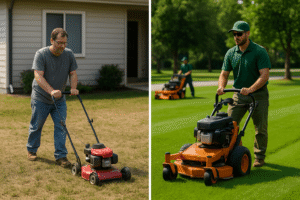
This comes down to how valuable your time is and whether you enjoy outdoor work. There’s no universal right answer.
DIY Pros:
You save money on labor costs. If you already own equipment, you’re only paying for fuel and your time. Even if you need to buy a mower, you’ll break even after 1–2 seasons compared to hiring out.
It can be rewarding. Many people find lawn care meditative or satisfying. There’s something primal about transforming an overgrown yard into a manicured space.
You have full control. You decide when to mow, how short to cut, and which areas need extra attention. No waiting for appointments or working around someone else’s schedule.
DIY Cons:
Equipment investment is significant. A decent residential mower costs $300–$800 for a push mower or $1,500–$3,500 for a riding mower. Add a trimmer ($150–$300), edger ($100–$200), and blower ($150–$400), and you’re looking at $700–$4,800 in equipment.
Time commitment adds up fast. Most homeowners spend 30–90 minutes per mow depending on yard size. That’s 2–6 hours monthly during growing season, or 20–70 hours per year.
Maintenance and storage required. Mowers need oil changes, blade sharpening, air filter replacements, and winterization. You also need garage or shed space to store everything.
You must mow regardless of weather, health, or vacation. Grass doesn’t stop growing because you’re sick or traveling. Fall behind, and you’ll face overgrown grass that’s twice as hard to cut.
Hiring Pros:
Zero time commitment. Providers show up on schedule and handle everything. You don’t lift a finger or break a sweat.
No equipment needed. No buying, maintaining, or storing lawn care equipment. No dealing with repairs or winterization.
Professional results. Experienced crews typically deliver cleaner edges, straighter lines, and more consistent results than most homeowners.
Consistent schedule. Your lawn stays maintained even when you’re busy, traveling, or unable to do it yourself.
Hiring Cons:
Weekly costs accumulate. At $50–$70 per week for 32 weeks, you’re spending $1,600–$2,240 annually. Over five years, that’s $8,000–$11,200.
Requires comparison shopping. Finding a reliable provider takes research, quotes, and sometimes trial and error.
Less control over timing. You work around their schedule, not yours. Delays due to weather or equipment issues affect you directly.
The break-even calculation
If you pay $60 per mow for 30 weeks annually, you spend $1,800 per year. A quality DIY setup costs $1,500–$3,000 upfront, so you break even in 1–2 years if you already have the time and physical ability.
But if your time is worth $30–$50 per hour professionally, spending 40–60 hours per year on lawn care has an opportunity cost of $1,200–$3,000. In that case, hiring out makes financial sense even beyond convenience.
What to Ask Before Hiring a Lawn Service
These questions protect you from unexpected charges and ensure you get what you’re paying for.
1. What exactly is included in each visit?
Get specifics. Does “lawn care” include mowing, trimming, edging, and blowing? Or just mowing? Are there limits on trimming time or areas covered?
2. Do you charge more for bi-weekly service?
Many providers charge 20–40% more per visit for bi-weekly service because grass is taller and takes longer to cut. Clarify this upfront.
3. Is edging included, and how often do you edge?
Some providers edge every visit. Others edge every other visit or only monthly. Make sure expectations align.
4. Do you mulch or bag clippings?
Most providers mulch clippings back into the lawn (which is better for grass health). Bagging usually costs extra because of disposal time and fees.
5. Are there extra charges for overgrown grass?
If you skip a week or grass gets too tall, will they charge extra? How much, and what’s the height threshold?
6. Are you insured and licensed?
General liability insurance protects you if equipment damages your property or someone gets injured. Don’t hire uninsured providers—you could be liable for accidents.
7. What’s your cancellation and rescheduling policy?
Can you pause service while traveling? How much notice do you need to give? Are there penalties for canceling mid-season?
8. How do you handle weather delays?
What happens if it rains on your scheduled day? Do they reschedule, or does your lawn wait another week?
9. Do you provide references or examples of your work?
Ask to see before/after photos or speak with current customers. Reliable providers are happy to share references.
10. How do you handle complaints or service issues?
Every provider occasionally misses a spot or shows up late. What’s their process for addressing concerns?
How to Compare Lawn Care Quotes (Even as a Beginner)
Comparing quotes fairly requires looking beyond the bottom-line price. Here’s how to evaluate providers objectively.
Look at yard size category
Make sure providers are quoting based on accurate square footage. A “medium yard” to one company might be “large” to another. Measure your yard or use satellite tools to get accurate dimensions.
Compare what’s included
A $50 quote that includes mowing, trimming, edging, and blowing beats a $45 quote that only includes mowing. List out every service each provider includes.
Check frequency assumptions
Is the quote for weekly, bi-weekly, or monthly service? Confirm the cadence so you’re comparing apples to apples.
Review before/after photos
Look at their work quality. Do edges look clean? Are lines straight? Is the overall result professional or sloppy?
Read reviews and check reliability
Online reviews reveal patterns. A few complaints are normal, but watch for recurring issues like no-shows, damaged property, or poor communication.
Evaluate actual results versus promises
The cheapest quote means nothing if they don’t show up consistently or deliver poor results. Sometimes paying $10 more per visit is worth it for reliability.
Consider communication quality
How responsive are they to questions? Do they provide written quotes and clear terms? Good communication usually indicates a well-run business.
This keeps you focused on what matters instead of getting distracted by price alone.
Sample Lawn Care Cost Chart (2025 Averages)
Use this chart as a baseline for evaluating quotes in your area.
Small yard (under 3,000 sq ft):
- Weekly: $35–$45
- Bi-weekly: $45–$55
- One-time/makeup visit: $60–$90
Medium yard (5,000–8,000 sq ft):
- Weekly: $45–$60
- Bi-weekly: $55–$70
- One-time/makeup visit: $75–$110
Large yard (10,000–15,000 sq ft):
- Weekly: $60–$85
- Bi-weekly: $75–$95
- One-time/makeup visit: $100–$150
Oversized yard (20,000+ sq ft):
- Weekly: $90–$150+
- Bi-weekly: $100–$170
- One-time/makeup visit: $150–$250
Regional adjustments to expect:
High cost-of-living areas (major metros, coastal cities): Add 20–40% to these ranges.
Rural or lower cost-of-living areas: Subtract 15–30% from these ranges.
Premium services (organic care, specialty grass types): Add 25–50% to standard pricing.
How to Get an Accurate Lawn Care Estimate
Follow these steps to ensure you receive fair, comparable quotes from multiple providers.
1. Measure your yard accurately
Use your property survey if you have one, or measure manually. Most lots are listed in your property records. You can also use free satellite measurement tools online.
Square footage matters enormously for pricing. Don’t guess.
2. Take photos of trouble spots
Document areas with lots of obstacles, steep slopes, tight spaces, or unique challenges. Share these photos with providers when requesting quotes.
Photos help them give accurate estimates without requiring an in-person visit first.
3. List your required services
Be specific. Do you want mowing only? Mowing, trimming, edging, and blowing? Additional services like fertilizing or weed control?
The clearer you are upfront, the fewer surprise charges you’ll encounter later.
4. Decide your frequency
Will you need weekly service during peak season (May–September)? Bi-weekly year-round? Monthly for maintenance-only periods?
Frequency dramatically affects annual costs, so nail this down before comparing quotes.
5. Ask for written quotes
Never accept verbal pricing alone. Get everything in writing: services included, frequency, price per visit, payment terms, and cancellation policy.
Written quotes protect both parties and prevent misunderstandings.
6. Request quotes from 3–5 providers
One quote gives you no context. Three to five quotes show you the market rate and help you identify outliers (suspiciously low or unreasonably high).
Don’t automatically choose the cheapest—evaluate the total package.
This ensures you receive a fair, apples-to-apples comparison that leads to a confident decision.
Final Thoughts
Pricing shouldn’t feel like a mystery. Now you know what’s reasonable, what’s included, what affects pricing, and how to compare quotes with confidence.
You understand that a $60 mowing visit isn’t “expensive” when you factor in equipment, fuel, insurance, travel time, and expertise. You know which questions to ask before hiring anyone. You can evaluate quotes objectively instead of guessing.
Whether you choose to DIY or hire a professional, you’re making an informed decision based on your budget, time, and priorities. You never need to second-guess a quote again.
The next time someone quotes you $75 for a mow, you’ll know exactly whether that’s fair for your yard size and location—and if it isn’t, you’ll know what questions to ask to get clarity.
That’s the power of understanding how lawn care pricing actually works.